Landscaping & Snow Removal
Caring for our community changes with the seasons. In the warmer months, that means traditional lawn care and the District's ongoing shift toward native, more water-wise landscaping. In winter, it means keeping our sidewalks and shared spaces safe and clear from ice and snow.
Here's what residents can expect from both:
Snow Removal

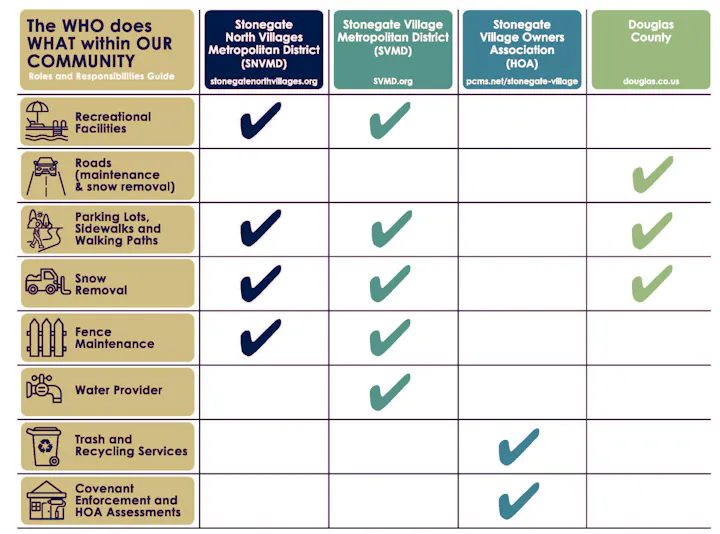
• The District contracts with a provider to clear all right-of-way sidewalks on, or adjacent to, common tracts owned by the District.
• The District also clears the main park sidewalks and manages snow removal for the two parking lots adjacent to the pool and tennis courts, as well as the park at the southeast corner of Keystone Boulevard and Aventerra Parkway.
• Snow removal is triggered any time accumulation exceeds two inches.
• Our contracted crews begin snow removal within twelve hours after snowfall has ceased, or as conditions safely permit.
• Snow removal on public streets throughout the District is handled by Douglas County, not the District. Residents can view the County's snow removal policies — including routes, priorities, and how to file a concern — at the Douglas County website.
Native Landscaping
Why the District is converting turf to native landscaping

Traditional turf lawn is still a big part of our community's landscape, and that's not changing; it's what residents use for recreation, gathering, and the look many of us associate with home. But increasingly, water is a limited resource each year, and a portion of our turf areas are largely ornamental and see very little everyday use. To use water more wisely, the we’re converting a select number of the lower-use areas to native grasses and plantings. These native areas need far less irrigation than a traditional lawn, and the water saved helps the District continue to support and maintain the turf areas residents rely on most.
What to expect from a native area
Native areas aren't maintained like a traditional lawn, and they aren't supposed to look like one. A few things to know:
• Establishment takes time. Native plantings can take up to three years to fully establish. During that period, it's normal for an area to look sparse or uneven as the grasses take root.
• Weeds are a healthy part of the process. Some weed growth is expected while native areas establish — especially after heavy rain or a slow start to spring. These areas are monitored and treated on an ongoing basis as weather, staffing, and site conditions allow.
• Mowing happens on a different schedule. Native grass is mowed far less often than turf — typically just once or twice a year rather than weekly. An area that looks “overdue” by lawn standards is likely not being neglected, but rather, just following its native maintenance schedule
• Watering is intentionally limited. Native areas have their own irrigation systems, run only as needed and at a much lower rate than a traditional lawn.
Native Landscaping Q&A
The District's landscaping team took the time to answer some of the community's more common and pressing questions about the native landscaping areas:
Why is the Metro District converting turf areas to native landscaping?
The primary reason is water conservation and reducing long-term water costs. The Metro District is required to follow drought restrictions and watering requirements established by the water district, which can significantly limit the amount of water available for landscaping during drought conditions. Because water is not an unlimited resource and drought conditions are expected to continue, the District is looking for ways to reduce its overall water demand.
Converting appropriate turf areas to native landscaping allows the District to use less water in those areas and prioritize its available water allocation for higher-priority landscaping, trees, and other plant material. It also supports the broader water conservation efforts being asked of residents throughout the community.
What are the benefits of native landscaping compared with traditional turf?
Native landscaping uses significantly less water once established, requires less mowing, can reduce long-term maintenance costs, and supports greater biodiversity and a healthier ecosystem. Aesthetically, however, it will look different from the traditional manicured turf residents may be accustomed to.
How much water is expected to be saved by converting these areas?
The exact savings depend on the size of the area, irrigation system, number and type of sprinkler heads, gallons used per minute, and irrigation run times. These factors can be calculated to estimate water savings. For example, if an area previously used approximately 10,000 gallons per watering day and ultimately no longer requires regular irrigation once established, that usage could largely be eliminated. Savings can then be calculated over the approximately 26-week irrigation season. Once fully established, native areas should also be much less affected by drought-related watering restrictions.
What will the area look like during the first year compared with once it is fully established?
The first year can look weedy, thin, patchy, and uneven. Converting turf to native requires disturbing the existing soil, which can expose dormant weed seeds and roots that have been in the soil for years. Weed control is particularly challenging while new native seed is germinating because broad chemical applications can also damage the new grass. Hand-pulling, selective mowing, and carefully timed spot treatments may be necessary during establishment.
How long does it take for a native area to become fully established?
Depending on the seed mix and site conditions, full establishment can take up to three years and may require additional seeding along the way. An area is generally considered successfully established when approximately 70% of the area has native grass coverage.
Why might some areas initially look thin, brown, or uneven?
Several factors can affect early growth, including the method used to distribute the seed, irrigation coverage, clogged sprinkler nozzles, changes in water pressure, heat, previous weed treatments, and the timing of seeding. Broadcast seeding can also naturally result in thicker growth in some areas and thinner growth in others. Even established native grasses can turn brown during periods of extreme heat or limited water.
How will weeds be controlled while the native grasses are establishing?
Weed management must be done carefully so the new native grass is not damaged. Early in the process, weeds may be hand-pulled where doing so will not disturb the new seedlings. Taller weeds may also be mowed above the height of the developing native grass to prevent them from going to seed. Once the native grass is sufficiently established, selective spot treatments can be used more frequently without jeopardizing the new grass.
Will the native areas still be irrigated? If so, for how long?
Yes. Native areas generally require regular irrigation during approximately the first two years while they establish. Irrigation frequency can then be reduced based on growth, weather, and site conditions. Once fully established, irrigation may potentially be shut off or substantially reduced to determine how well the native grass performs under natural precipitation and drought conditions.
How often will native areas be mowed or maintained once established?
Once established, native areas may generally be mowed approximately twice per year, typically in the spring and fall, although additional maintenance may be necessary for weed control. Mowed “beauty bands” along sidewalks and other edges can be maintained more frequently to provide a cleaner appearance and separation between taller native grasses and pedestrian areas. These bands can also help with visibility and concerns related to wildlife near sidewalks.
Why were these particular locations selected for conversion?
Areas are selected based on factors such as water use, irrigation needs, location, existing landscape conditions, and whether native landscaping is appropriate for the function and appearance of the particular area.
What happens if an area does not establish successfully?
Areas that do not establish successfully can be reseeded. Because many of the native varieties are warm-season grasses and establishment takes time, additional seeding may be necessary before the area reaches the targeted coverage. Approximately 70% coverage is considered an established native area.
Will dead or unsuccessful areas be reseeded or repaired?
Yes. Areas that do not establish adequately can be evaluated and reseeded as necessary.
Does native landscaping mean the Metro District will stop maintaining these areas?
No. Native landscaping requires a different type and frequency of maintenance than traditional turf. Weed management, mowing, irrigation monitoring, reseeding, and other maintenance will continue as necessary.
What should residents expect the finished native landscape to look like?
Native landscaping will not have the uniform appearance of traditional turf. The seed mix contains different varieties and heights of grasses—for example, a mix may contain approximately 60% low-growing grasses with the remaining portion consisting of taller varieties. Because different seeds establish at different rates and in different locations, some natural variation is expected. The appearance will also change throughout the seasons. Native landscaping can be an adjustment for residents accustomed to manicured turf, but the less-uniform appearance is an intentional characteristic of this type of landscape.
Will native areas be fertilized?
Fertilizer can be used if necessary, but native grasses typically do not require routine fertilization once established.